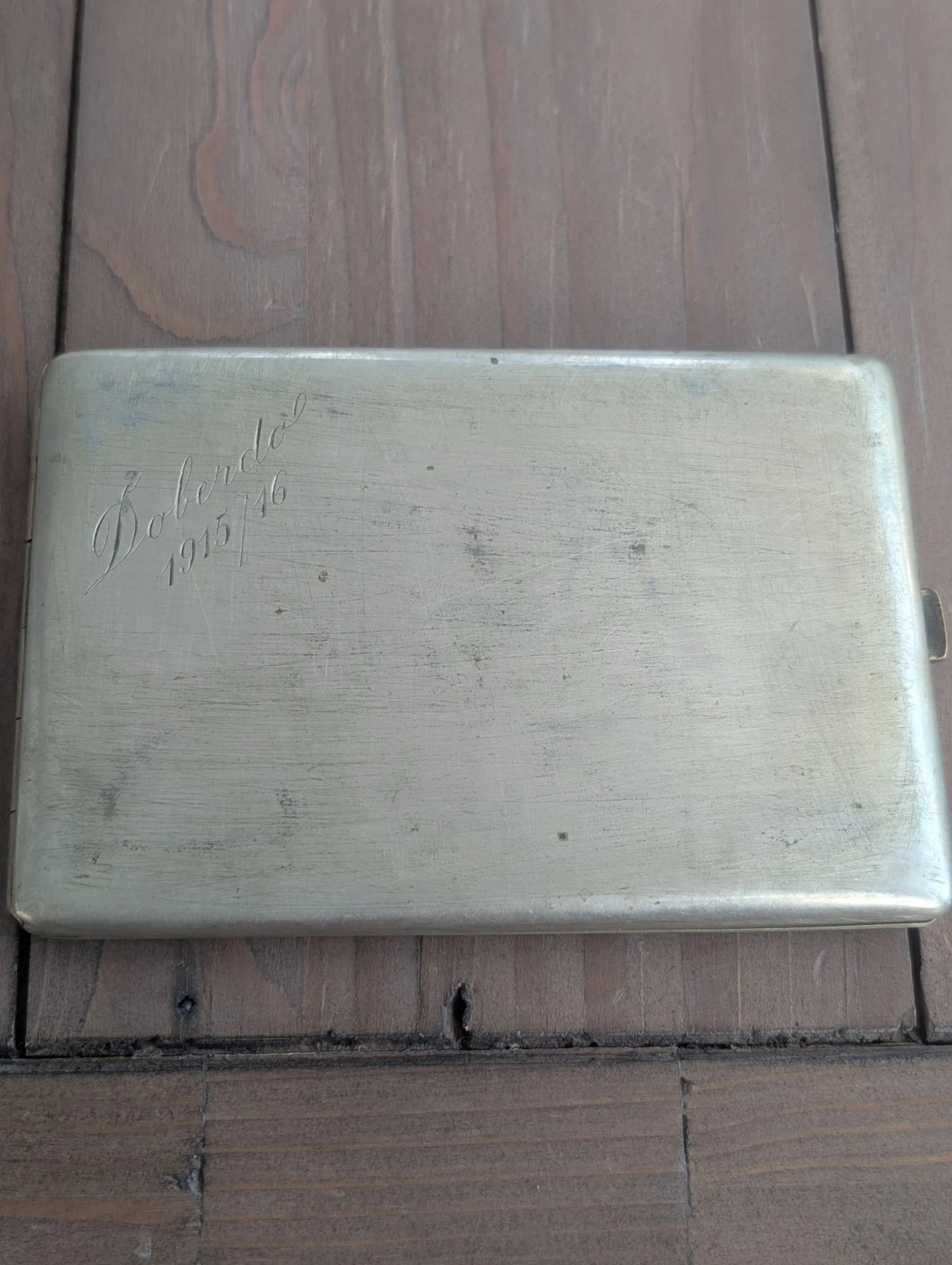
Where is Doberdò, and why do the dates matter?
Doberdò del Lago is a settlement on the Karst plateau in today's north-eastern Italy, near the former fighting ground of the Isonzo Front. During the First World War, Italian and Austro-Hungarian forces fought repeated battles along the Isonzo, with the plateau becoming a particularly hard-contested area.
The National Army Museum's Isonzo timeline dates that series of battles from June 1915 into 1917. The Monte San Michele museum documents the neighbouring Lower Isonzo front and the Doberdò plateau, including the events of 1916. So the words “Doberdò 1915–16” refer to a real place and a highly significant wartime period.
That historical connection makes the engraving interesting to a collector of First World War memorabilia. It does not, by itself, prove when this particular case was made or who carried it.
What we can actually observe about the case
The item in our collection is a used vintage metal cigarette case with the inscription “Doberdò 1915–16”. The case weighs approximately 106 grams. A marking reading “L. PACCA” has been reported, along with additional small marks that have not been independently identified.
Doberdò 1915–16 inscription; approximately 106g weight; visible wear; L. PACCA marking; case closes.
Original owner; exact manufacturing date; whether it was wartime-used; maker attribution; precious-metal fineness.
It reportedly does not attract a magnet, but a magnet test cannot establish that an item is silver. Many other metals are also non-magnetic. A worn stamp that resembles “800” is not sufficient on its own to guarantee 800-grade silver. Hallmark research or professional metal testing would be needed before making that claim confidently.
How to assess an inscribed WWI-era cigarette case
- Read the engraving carefully. Check the spelling, accents, numbers and whether lettering appears consistent across the inscription.
- Photograph all marks. Use sharp close-ups in raking light to show maker names, possible fineness stamps and wear.
- Check the construction. Hinges, clasp, lining and signs of repair can be as important as the decoration.
- Separate family stories from proof. Documents, service records or a continuous ownership history are stronger evidence than an inscription alone.
- Test the metal properly. If silver content affects the price, seek a reliable professional assessment rather than relying on colour or magnet response.
- Compare like with like. Look at actual sold results for similar inscribed metal cases, accounting for condition and documented provenance.
Why a personal object can tell a bigger story
Small, practical objects often survive without paperwork. Their inscriptions can preserve place names, personal memories or dates long after the original context has been lost. Here, Doberdò points toward a front that saw prolonged fighting and tremendous human loss.
We think that makes the case worth a closer look as an historical curiosity. But the most respectful way to present it is to let the confirmed historical setting speak for itself and be open about what remains a mystery.
Explore the original case.
See the actual photograph, recorded markings, item notes and the current route to its eBay listing.
Further historical reading
This article discusses historical context, not authenticated ownership or a professional valuation of the object. The item's age, composition and military use have not been independently established. Current availability and price should be checked on eBay.